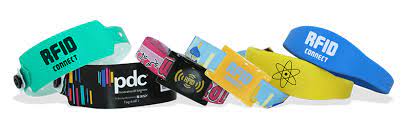
Radio-Frequency Identification (RFID) wristbands communicate with a reader and transfer data using radio waves. Transponders are used as a form of identification and ticketing at events and venues, allowing event-goers to access certain areas, purchase food and drinks, and track their activities. The wristbands include a small microchip and antenna for storing unique identification information and communicating with an RFID reader. The reader then sends the data to a backend system, which updates the data in real-time and allows event organizers to manage and track attendees’ active participation.
An RFID bracelet employs a smart tag’ embedded in the wristband that stores and transmits data to an RFID reader. RFID tags are commonly attached to wristbands or bracelets in the festival industry, but there are many options for storing RFID wristbands at any event. And it’s also discreet, comfortable, and on-trend. They can be easily color coordinated (for example, if you need several different layers of access to the same event), and you can choose any level of security or durability with the various materials now available.
RFID Definition And Operation
RFID (Radio-Frequency Identification) is a technique that communicates with a viewer and a tag connected to an item via radio waves, enabling the item to be recognized, monitored, and controlled remotely.
An RFID System’s Fundamental Components Are As Follows:
- RFID Tag: A tiny device with just a transmitter and a microcontroller attributed to the different identification data.
- RFID Reader: A radio-emitting machine that receives input from the tag.
- Antenna: A radio wave transmitting and receiving component.
- Data storage: A element that stores information well about a tag, such as its unique identifier.
When such an RFID reader is powered up, it generates a radio frequency that the tag’s antenna detects. The tag then transmits its unique identifying details to the reader via radio waves. The reader decodes the data and transmits it to a computer system, where it is digested and used to track and control the monitored objects.
RFID Technology Is Being Used Strategically At Events And Venues
Since 2016, the adoption of RFID at events has risen in popularity. While large music festivals were the early adopters, RFID technology is no longer limited to them. RFID technology is now being used in a variety of industries, including sports stadiums and arenas, art shows, hotels and resorts, theme parks, and places of interest.
RFID wristband technology is not only used for cashless transactions. RFID technology’s primary applications are concentrated in three distinct areas: RFID for cashless payments, RFID for network access and business management software, and RFID for brand activation. Let’s get a little more specific.
- Access control: RFID tags can be used to award or constrain access to certain areas of a performance space, such as VIP areas, backstage areas, or limited access areas.
- Attendee tracking: RFID tags are able to track attendees’ movement inside a facility, offering insight into foot traffic conditions and assisting event organizers in optimizing their time and resources.
- Cashless money transfers: RFID technology can be used to enable cashless transactions at events including purchasing food and beverages purchases, merchandise sales, and ticket purchases.
- Asset tracking: RFID tags can be employed to record devices, materials, or other resources, reducing the risk of theft or loss.
- Real-time data: RFID systems can provide event organizers with real-time data on attendee behavior and transactions, which allows them to make knowledgeable decisions on the fly and enhance the entire expertise of participants.
The Main Advantages Of Using RFID For Events
Real-time Tracking: RFID technology allows for real-time tracking of attendees, assets, and inventory, giving event organizers real-time insights and improved decision-making capabilities.
Improved Attendee Experience: RFID technology can enhance the overall attendee experience by allowing for faster check-ins, connecting control to occasion areas, and quick money transfers.
Enhanced Security: RFID technology can improve security by letting event organizers track participants and supervise exit and entry points, adding an extra layer of security for guests.
Increased Efficiency: RFID technology has the potential to significantly improve event operations efficiency by automating procedures, reducing manual errors, and simplifying data gathering
Data Collection and Analytics: RFID technology provides real-time data to event organizers, which can be analyzed to help understand delegates’ actions and make informed decisions for events in the future.
Rundown
When you’re serious about raising revenue, lowering costs, and improving the guest experience with RFID, we recommend reading this guide and the affiliated blogs. We tried to keep it as brief and terminology as feasible. Every business is unique and faces its own set of challenges. We didn’t write this guide to replace conversations, but we’d love to hear from you! So, if you’d like to learn more regarding the cost of implementing RFID wristbands or the possible benefits for your company, please contact us.