
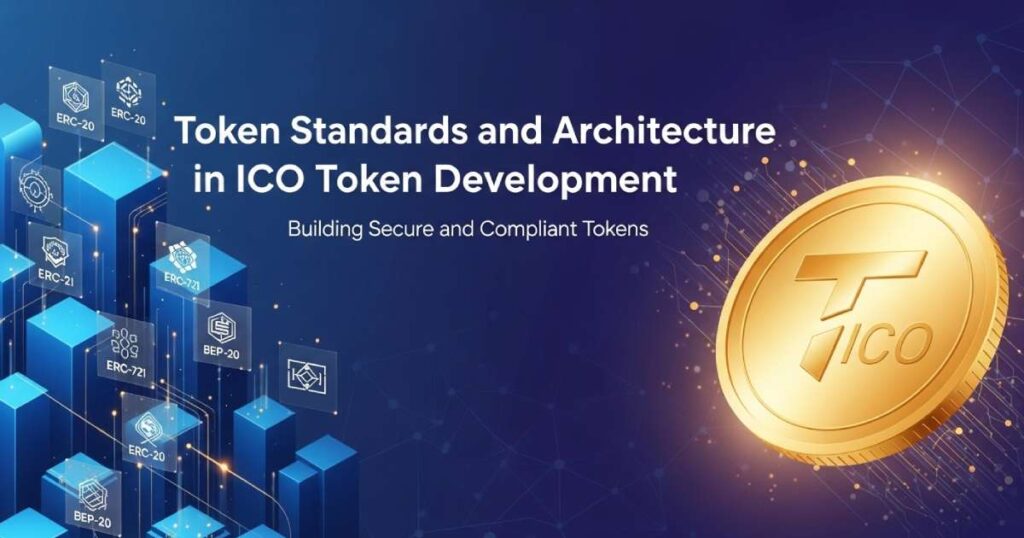
An ICO can succeed or fail long before the public sale opens. Many teams still treat token creation as a branding decision, a fundraising layer, or a technical box to check near the end of product planning. In practice, the opposite is true. The token standard and the architecture behind it shape how the asset behaves in wallets, how exchanges integrate it, how users interact with it, how smart contracts compose around it, and how the project handles upgrades, permissions, compliance controls, and long-term utility. That is why serious ICO token development starts with infrastructure choices, not marketing promises.
At the center of this decision sits a simple question: what kind of asset is being issued, and what system is it meant to serve? Ethereum’s ERC-20 standard became foundational because it defined a reusable interface for fungible tokens, allowing wallets, exchanges, and decentralized applications to interact with tokens in a predictable way. That interoperability is the real reason standards matter. A token that follows widely adopted interfaces can move more smoothly across the market, while a token with unnecessary custom behavior often creates integration friction, audit complexity, and operational risk.
Why token standards matter in ICO development
A token standard is not just a coding template. It is a ruleset that tells the ecosystem how to read, transfer, approve, or otherwise interact with an asset. In ICO token development, this matters because a public token sale usually aims for broad post-sale usability. Investors expect wallet support, exchange compatibility, transparent supply mechanics, and reliable transfer behavior. Developers need clear interfaces for treasury management, vesting, staking, governance, and integrations with external protocols. Standards reduce uncertainty on both sides.
The importance of standards becomes even clearer when comparing token launches that scale with those that stall. Projects that use recognized interfaces can plug into existing infrastructure more quickly. Custodians, market makers, explorers, analytics platforms, and listing teams do not need to reverse-engineer unusual logic. That does not mean every token should be minimal. It means custom features should be added on top of a standard baseline only when the business model genuinely requires them. In other words, the standard should provide compatibility, while the architecture provides differentiation.
ERC-20 and why it remains the default ICO standard
For most ICOs, ERC-20 remains the baseline starting point. The standard defines the core functions and events needed for fungible token behavior, including transfers, balances, allowances, and approvals. Its enduring strength comes from market acceptance. A compliant ERC-20 token can be recognized by wallets, decentralized exchanges, custodial systems, and a wide range of on-chain applications because those systems were built around the standard interface.
That said, ERC-20 is only the beginning. A well-built ICO token development rarely lives as a plain transfer asset. It may need minting controls, supply caps, pausing abilities, role-based permissions, snapshots for voting, permit-based approvals, or compatibility with staking and treasury contracts. OpenZeppelin’s token libraries reflect how mature token engineering has become: teams are no longer deciding only whether to mint a token, but how to build one with explicit access control, tested contract modules, and safer operational patterns.
A practical example is the growing use of ERC-20 permit functionality through EIP-2612. The standard extension allows token holders to approve spending through an off-chain signature rather than a separate on-chain approval transaction. That reduces friction because users can often combine approval and action into a smoother flow. For ICO projects, that matters after launch. The easier it is for holders to stake, swap, subscribe, or interact with protocol utilities, the more likely the token becomes usable rather than purely speculative.
Beyond ERC-20: when other standards become relevant
Not every ICO-related asset belongs under a single fungible token standard. Some token sale ecosystems involve access passes, vesting certificates, claim tokens, loyalty assets, membership credentials, or digital ownership instruments that behave differently from a standard utility token. That is where broader architectural thinking becomes necessary.
ERC-721 is designed for non-fungible tokens, where each token is unique and individually traceable. Although ERC-721 is not the usual choice for the ICO sale asset itself, it can play a meaningful supporting role. Projects sometimes use NFTs for tiered access, founder passes, governance badges, investor accreditation markers, or tokenized entitlements linked to specific rights or identities. The key point is architectural separation: the main ICO asset may remain ERC-20, while certain rights or participation layers can be modeled separately as non-fungible assets.
ERC-1155 extends this idea by allowing multiple fungible and non-fungible token types inside a single contract. This becomes useful when an ICO project plans a broader ecosystem rather than a single sale token. Gaming, loyalty, marketplace, and infrastructure projects often benefit from a multi-asset design because it reduces the need to deploy and maintain many isolated contracts. A project could issue a core fungible utility token alongside distinct access items, reward assets, or semi-fungible campaign instruments from one framework. The advantage is efficiency, but the trade-off is complexity. A team should not adopt ERC-1155 merely because it is flexible; it should do so only when the business model truly involves multiple asset classes.
Chain choice changes architecture, not just fees
In older ICO conversations, token standards were often discussed as if the only real choice was Ethereum. That is no longer accurate. Today, teams building ICO token development services or launching their own token generation events have to think across ecosystems. The standard may still resemble ERC-20 in one environment, but architecture changes significantly once the chain changes.
On BNB Smart Chain, BEP-20 remains closely aligned with ERC-20 logic, which is why many teams choose it for lower-cost issuance and easier migration of EVM-compatible code. The similarity reduces development friction for teams already familiar with Ethereum-style smart contracts. Yet the chain decision still affects liquidity strategy, validator environment, bridge exposure, user base, transaction economics, and exchange listing pathways. Choosing BEP-20 is therefore not just about cheaper gas. It is a market architecture choice tied to audience, usage patterns, and ecosystem depth.
Solana introduces a different architectural model altogether. SPL tokens function through Solana’s token programs, and the ecosystem now supports token extensions through Token-2022. Those extensions allow optional features at the token-program level, including transfer fees and non-transferability, though some extensions are incompatible with others. This matters because it shows how token architecture is evolving: certain behaviors that EVM teams often build manually into custom contracts can, in some ecosystems, be handled more natively at the token layer. For an ICO team, that can be attractive, but it also means architecture decisions must be made earlier and with greater care. Once you enable or combine specific token behaviors, you shape wallet compatibility, exchange support, and long-term governance assumptions.
Core architectural decisions in ICO token development
Choosing a standard is only one part of the build. The deeper work lies in architecture. That includes how the token contract is structured, who controls supply, how rights are separated, and how the token interacts with the wider sale and post-sale environment.
Fixed supply vs mintable supply
A fixed-supply model is often seen as simpler and more credible because it removes uncertainty around future issuance. For many ICOs, especially those selling a clear percentage of total supply to the market, this improves transparency. Yet some ecosystems need minting flexibility for rewards, ecosystem incentives, or future expansion. In those cases, the token can still be credible, but mint authority must be governed tightly, disclosed clearly, and ideally limited through caps, schedules, or multi-signature oversight. Architecture should never leave supply policy vague. Vague issuance is one of the fastest ways to damage trust.
Monolithic contract vs modular system
A single contract can appear easier to deploy, but modular design is usually healthier for serious projects. Instead of packing sale logic, vesting, treasury controls, governance hooks, and emergency mechanisms into one contract, many mature architectures separate these functions. The token contract handles token behavior. A crowdsale or distribution contract handles sale mechanics. Vesting contracts manage team and advisor unlocks. Treasury contracts handle reserves. Governance or staking contracts sit on top of the token rather than inside it. This separation reduces attack surface, improves auditability, and makes upgrades more disciplined.
Upgradeability vs immutability
This is one of the most important trade-offs in ICO token architecture. Immutable contracts create confidence because users know core behavior cannot be changed casually after launch. At the same time, fully immutable systems can become difficult to maintain if bugs, regulatory needs, or business requirements emerge. Upgradeable patterns can address that risk, but they introduce governance and trust questions. Who can upgrade? Under what process? With what delay, visibility, or community oversight? Good architecture does not hide this tension. It documents it openly and builds appropriate safeguards around it.
Access control and emergency powers
Token contracts often require operational roles, but those roles must be narrow and explicit. OpenZeppelin’s security and access patterns reflect common needs such as pausing functionality or preventing unauthorized privilege use. In an ICO setting, this matters because operational shortcuts taken early can become governance liabilities later. A pause mechanism may be reasonable for incident response. Unlimited administrative authority is not. Investors and users need clarity around who can mint, burn, pause, blacklist, upgrade, or redirect treasury functions.
The sale architecture matters as much as the token
A token can be technically sound and still fail in an ICO because the sale architecture is weak. The token contract is only one layer. The fundraising structure around it shapes how fairly and securely distribution happens.
A robust ICO architecture typically separates token issuance from token sale execution. The sale contract should define accepted payment assets, price calculation logic, caps, whitelisting rules, claim schedules, refund logic where applicable, and finalization conditions. Vesting should usually be handled through dedicated contracts rather than informal promises. Lockups for founders, advisors, and ecosystem allocations should be visible on-chain wherever practical. This is not only a technical issue. It is a market credibility issue. Architecture becomes part of investor due diligence.
This is also where compliance and geography start influencing design. Some projects need transfer restrictions during early phases. Others need controlled unlock schedules or claim-based distributions instead of instant release. The token standard must be able to support the sale structure, and the sale structure must reflect the legal and commercial reality of the offering.
Real-world lessons from token architecture choices
The history of token markets shows the difference between standards-driven design and rushed customization. Projects that launched with familiar, auditable token behavior generally found it easier to integrate with wallets and exchanges. Projects that embedded too much custom logic directly into token contracts often created friction for listings, confused holders, or introduced hard-to-audit failure points.
One of the clearest lessons from the broader market is that architecture should match function, not ambition. A payments or utility token often benefits from a conservative ERC-20 or BEP-20 design with clear transfer behavior and strong treasury controls. A multi-asset platform may justify ERC-1155. A tokenized identity, membership, or certificate layer may justify ERC-721 or a token extension model. Trouble starts when teams choose exotic structures before proving they actually need them.
Another major lesson concerns post-ICO usability. A token that cannot be used easily inside the product tends to drift toward pure speculation. Standards like ERC-20, paired with architectural extensions such as permit-based approvals, better wallet support, and contract composability, help reduce that gap between ownership and usage.
What a strong ICO token architecture looks like in practice
The best ICO token architecture usually looks less flashy than inexperienced founders expect. It tends to include a standard-compliant fungible token contract, well-scoped permissions, separate vesting and treasury contracts, documented allocation logic, limited upgrade authority, audited libraries, and sale infrastructure built to be transparent rather than clever. The aim is reliability.
A strong architecture also plans for life after fundraising. That means asking practical questions early. How will the token be used inside the product? Can exchanges and custodians support it without extra work? Can governance evolve without breaking core token logic? Can the project add features through adjacent contracts instead of rewriting the token itself? Is cross-chain expansion planned, and if so, how will wrapped or mirrored versions be managed without confusing supply integrity?
These are architecture questions, but they are also business questions. The token is not an isolated code artifact. It is the operating asset of a larger system.
Conclusion
Token standards and architecture sit at the foundation of ICO token development. Standards provide the language that the blockchain ecosystem understands. Architecture determines how that language is applied in a real, functioning sale and post-sale environment. Together, they influence usability, security, compliance readiness, exchange compatibility, and long-term product value.
For most ICOs, the smartest path is not to invent a new standard or overload the token with every possible feature. It is to start from a proven interface such as ERC-20 or its ecosystem equivalent, then build a disciplined architecture around supply control, permissions, sale execution, vesting, governance, and future integrations. Sophisticated token design is not about how much complexity a team can add. It is about how much unnecessary complexity it can avoid while still supporting the economics and utility of the project.
That is the real difference between a token built to raise money and a token built to function.


