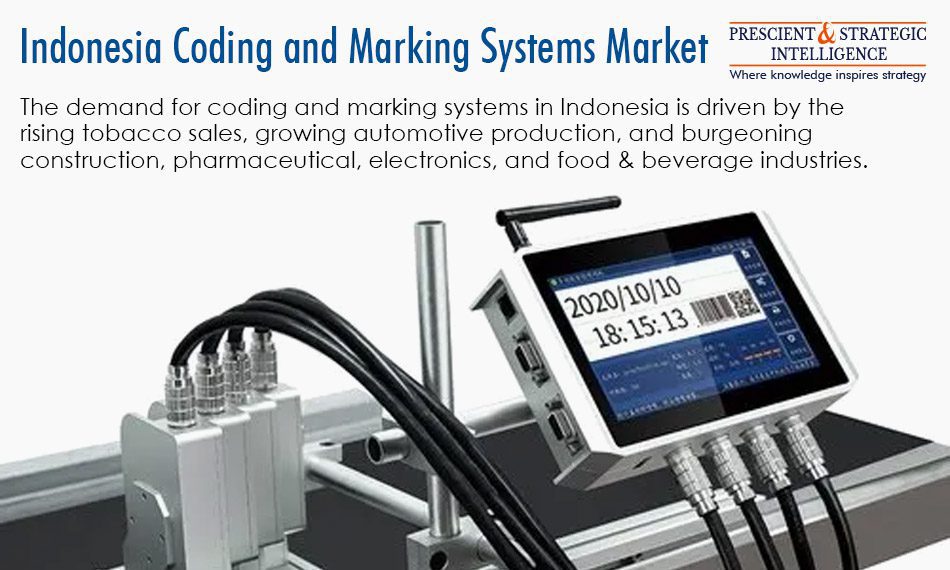
Coding and marking requirements in the manufacturing and processing sector of Indonesia were traditionally met with the use of analog technologies. However, in recent years, manufacturers here have shifted to digital coding and marking solutions owing to the increasing complexities in product packaging. As a result, the country has now shifted toward high-tech, sensitive printers. Now, manual systems are being substituted with continuous inkjet printers for working on product packaging.
In particular, the tobacco industry is generating a high demand for such modern and sophisticated coding solutions to ensure the quality of the end products, owing to the rising emphasis on cleanliness. Modern coding technologies facilitate enhanced readability and high-resolution printing for automatic labeling and direct-to-the-box applications. Thus, the Indonesian coding and marking systems market is expected to grow from $27.4 million in 2017 to $48.7 million by 2023, at a CAGR of 10.1% during the forecast period (2018–2023).
According to P&S Intelligence, the food and beverages sector has also emerged as a significant user of coding and marking solutions in Indonesia. This industry uses these solutions for printing elemental product information, such as batch number, manufacturing and expiry dates, and price, on the packaging, for identification and tracking purposes. Apart from the tobacco and food and beverages industries, the electrical and electronics, chemical, healthcare, marine, military, building and construction, automotive, cosmetics, and personal, and homecare sectors to employ coding and marking systems
The application segment of the Indonesian coding and marking systems market is classified into polyethylene terephthalate (PET) bottles, metal parts, metal cans, bags, wooden materials, flexible films and foils, plastic and rubber parts, rigid plastic containers, extrusions, glass bottles and containers, shrink wrap, paperboard, retail-ready packaging, corrugated packaging, and others, including pouches, cases, and trays. In 2017, the PET bottles category held the largest market share due to the extensive use of these bottles for the packaging of beverages.
For all these applications, continuous inkjet, thermal inkjet, thermal transfer overprinting (TTO), drop-on-demand (DoD), laser coding and marking, print and apply, hot-melt inkjet, and valve jet coding and marking technologies Are used. In the past, the continuous inkjet technology was preferred among end users due to its low operational cost. However, in the coming years, the adoption rate of the laser coding and marking technology will be the highest because it offers enhanced readability of the text and 2D codes on the product packaging.